


Introduction
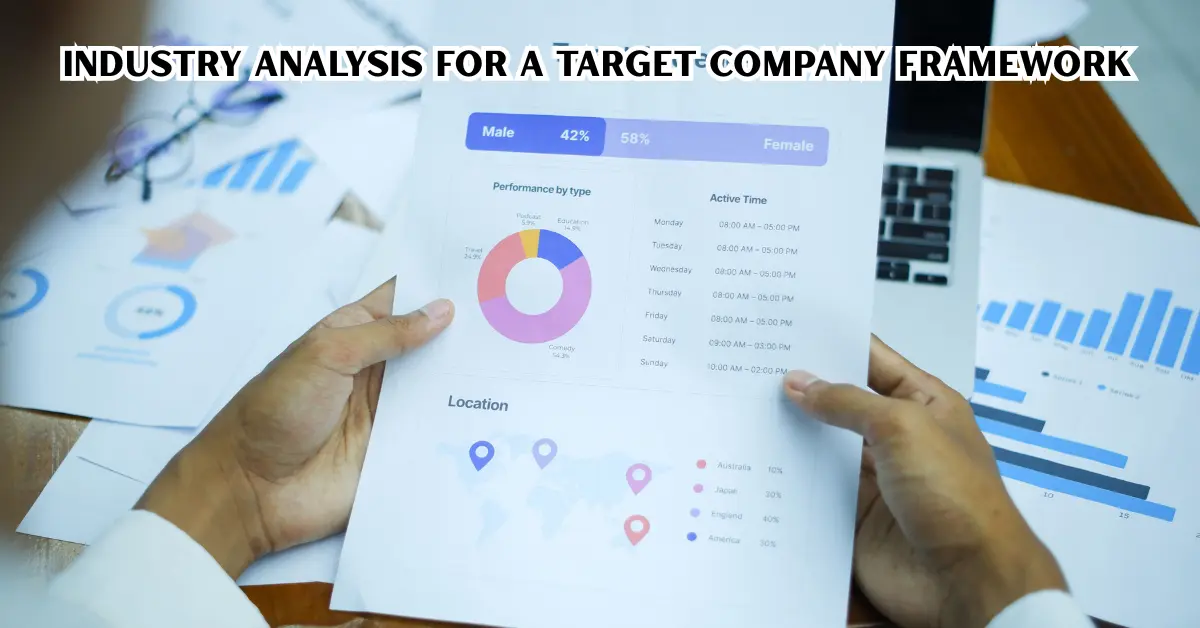
Industry Analysis for a Target Company is the process of studying the industry in which a company operates to understand its market environment, competition, growth opportunities, risks, customers, and future outlook. Before evaluating a target company, investors, business owners, analysts, and decision-makers need to understand the broader industry because company performance is often influenced by external market conditions.
A company may have strong revenue, an experienced management team, and valuable products, but its future performance can still be affected by changes in customer demand, competitors, technology, regulations, suppliers, and economic conditions.
This guide explains Industry Analysis for a Target Company step by step. You will learn how to identify the target industry, analyze its size and growth, evaluate competitors, understand customers, study industry trends, assess risks, examine competitive forces, and use the findings to make a more informed company analysis.
What Is Industry Analysis for a Target Company?
Industry Analysis for a Target Company means evaluating the external business environment surrounding a specific company. Instead of looking only at the company’s internal financial statements, the analysis examines the market and industry conditions that can influence its performance.
For example, if you are analyzing a software company, you should not only examine its revenue and expenses. You should also study software demand, competing products, technology changes, customer expectations, pricing models, regulations, and barriers to entry.
The main purpose is to answer questions such as:
- How attractive is the company’s industry?
- Is the industry growing, stable, or declining?
- Who are the company’s major competitors?
- What factors influence customer demand?
- What risks could affect future growth?
- How difficult is it for new companies to enter the market?
- What opportunities could support the target company’s expansion?
Industry analysis provides the context needed to understand why a company is performing the way it is.
Why Is Industry Analysis Important?

A company’s performance cannot always be understood by examining the company alone. Industry conditions can create opportunities or limitations that affect almost every business operating in the same market.
A proper Industry Analysis for a Target Company helps analysts understand the environment surrounding the business.
1. Understand Market Conditions
Industry analysis shows whether demand for products or services is increasing, stable, or decreasing. This provides important context when reviewing company revenue and customer growth.
2. Identify Competitors
The analysis helps identify direct competitors, indirect competitors, emerging businesses, and alternative solutions competing for the same customers.
3. Discover Growth Opportunities
Industry trends can reveal opportunities such as new customer segments, geographic expansion, technological developments, or changing consumer preferences.
4. Identify Industry Risks
Every industry has risks. These may include regulatory changes, technological disruption, supply chain problems, intense competition, changing customer behavior, or economic pressure.
5. Understand Company Position
The target company’s market share, pricing strategy, brand position, product quality, and competitive advantages become easier to understand when compared with industry conditions.
Key Components of Industry Analysis for a Target Company
A complete analysis should examine several important areas rather than relying on one metric.
The major components include:
- Industry definition
- Market size
- Industry growth
- Market segmentation
- Customer behavior
- Competitor analysis
- Industry trends
- Technology
- Regulatory environment
- Supplier and buyer power
- Barriers to entry
- Substitutes
- Industry risks
- Future opportunities
Each component contributes a different piece of information to the overall picture.
Step 1: Define the Target Company’s Industry
The first step in Industry Analysis for a Target Company is identifying exactly which industry the company belongs to.
This sounds simple, but many businesses operate across multiple categories.
For example, an online retailer could belong to:
- E-commerce
- Retail
- Consumer products
- Logistics
- Digital commerce
The appropriate industry depends on the company’s primary business activities and revenue sources.
How to Define the Industry
Start by examining:
- Main products or services
- Primary customers
- Revenue sources
- Geographic markets
- Business model
- Main competitors
- Customer problems the company solves
A clear industry definition prevents the analysis from becoming too broad or irrelevant.
Step 2: Analyze Industry Size and Growth
After defining the industry, examine its size and growth characteristics.
Industry size can be evaluated using measures such as revenue, number of customers, transaction volume, company count, or other relevant market indicators.
Industry growth helps determine whether the market is expanding or becoming more difficult for businesses.
Questions to Ask
When evaluating industry growth, consider:
- Is customer demand increasing?
- Are new businesses entering the market?
- Are existing companies expanding?
- Are customers spending more or less?
- Is technology creating new demand?
- Are products becoming obsolete?
- Are new geographic markets opening?
Growth does not automatically mean that every company in the industry will succeed. A growing market can still contain intense competition.
Step 3: Understand Industry Segmentation
Most industries contain multiple customer groups and market segments.
For example, the technology industry can include enterprise software, consumer applications, cybersecurity, cloud services, hardware, and many other segments.
Industry Analysis for a Target Company should identify the specific segment where the target company generates most of its revenue.
Analyze segmentation by:
- Customer type
- Geography
- Product category
- Price level
- Business size
- Distribution channel
- Customer needs
This helps determine whether the target company operates in an attractive niche or a highly competitive segment.
Step 4: Study the Target Company’s Customers
Customer analysis is an important part of Industry Analysis for a Target Company because industry demand ultimately comes from customers.
Determine who purchases the industry’s products or services and why they make purchasing decisions.
Important customer factors include:
- Age and demographics where relevant
- Business size
- Income or purchasing capacity
- Customer needs
- Buying frequency
- Price sensitivity
- Brand preferences
- Switching behavior
- Product expectations
Customer Questions
Ask:
- Who are the main customers?
- What problem are they trying to solve?
- What factors influence their buying decision?
- How sensitive are they to price?
- How easily can they switch to another provider?
- What changes are occurring in customer expectations?
Understanding customers can also help explain why one company performs differently from another within the same industry.
Step 5: Analyze Industry Competition
Competition is one of the most important areas of Industry Analysis for a Target Company.
Start by identifying the major companies operating in the same market. Then compare their products, pricing, positioning, distribution, technology, customer base, and competitive advantages.
A useful competitor analysis can include:
| Factor | Target Company | Competitor A | Competitor B |
| Main Product | Product offered | Product offered | Product offered |
| Target Customers | Customer group | Customer group | Customer group |
| Pricing | Pricing model | Pricing model | Pricing model |
| Distribution | Main channels | Main channels | Main channels |
| Competitive Advantage | Key strength | Key strength | Key strength |
| Market Position | Current position | Current position | Current position |
The goal is not simply to count competitors. The goal is to understand how competition affects the target company’s ability to attract customers and generate sustainable revenue.
Step 6: Examine Industry Trends
Industry trends can significantly affect a company’s future.
A trend may create new opportunities, increase costs, change customer expectations, or make an existing business model less effective.
When conducting Industry Analysis for a Target Company, examine trends related to:
- Technology
- Consumer behavior
- Pricing
- Regulation
- Sustainability
- Distribution
- Automation
- Digital transformation
- Product innovation
- International markets
Separate temporary changes from long-term structural trends whenever possible.
For example, a short-term increase in demand may not represent permanent industry growth. Analysts should look for evidence of whether a trend is likely to have lasting business implications.
Step 7: Use Porter’s Five Forces
Porter’s Five Forces is a commonly used framework for examining competitive pressure within an industry.
The five forces are:
Competitive Rivalry
This measures the level of competition among existing companies.
Competition may be intense when many businesses offer similar products and compete heavily on price, features, marketing, or customer service.
Threat of New Entrants
This examines how easily new companies can enter the industry.
Barriers may include:
- High capital requirements
- Strong existing brands
- Regulatory requirements
- Specialized technology
- Distribution networks
- Customer loyalty
- Economies of scale
Higher barriers can make it more difficult for new competitors to enter.
Bargaining Power of Suppliers
Suppliers can influence costs, availability, quality, and contract terms.
Supplier power may be higher when there are only a few suppliers or when the supplied product is difficult to replace.
Bargaining Power of Buyers
Customers can have significant power when they have many alternatives or can easily switch between providers.
Buyer power can affect pricing and profit margins.
Threat of Substitutes
A substitute is an alternative solution that satisfies the same customer need.
For example, customers may replace one type of product with another technology or service that solves the same problem.
These five forces help explain the competitive structure surrounding the target company.
Step 8: Analyze Technology and Innovation
Technology can change entire industries.
During Industry Analysis for a Target Company, identify technologies that could improve the company’s operations or threaten its existing products.
Consider:
- Automation
- Artificial intelligence
- Cloud technology
- Mobile technology
- Data analytics
- Cybersecurity
- Manufacturing technology
- Digital payment systems
- New production methods
The key question is not simply whether new technology exists. Instead, determine how the technology could affect customers, competitors, costs, products, and business models.
Step 9: Evaluate the Regulatory Environment
Government regulations can significantly affect businesses.
Depending on the industry, regulations may cover:
- Licensing
- Taxes
- Consumer protection
- Data privacy
- Employment
- Environmental requirements
- Financial reporting
- Product safety
- Import and export activities
A strong Industry Analysis for a Target Company should identify regulations that directly influence the company’s operations.
Regulatory analysis should distinguish between existing requirements and proposed changes because future policy changes may be uncertain.
Step 10: Identify Industry Opportunities and Threats
After studying the market, competitors, customers, technology, and regulations, organize the findings into opportunities and threats.
Potential Opportunities
Opportunities may include:
- Growing customer demand
- Underserved market segments
- New geographic markets
- Product innovation
- Digital expansion
- New distribution channels
- Changing customer preferences
Potential Threats
Threats may include:
- Increasing competition
- New substitutes
- Regulatory restrictions
- Higher operating costs
- Technology disruption
- Declining demand
- Supplier dependency
- Economic pressure
This section connects the broader industry analysis with the target company’s potential future performance.
Benefits of Industry Analysis for a Target Company
A structured Industry Analysis for a Target Company offers several practical benefits.
Better Strategic Understanding
It helps explain where the company fits within its market and what external forces influence its performance.
Improved Competitive Analysis
Analysts can compare the target company’s position with competitors instead of evaluating it in isolation.
More Informed Risk Assessment
Industry analysis identifies external threats that may not appear directly in financial statements.
Better Growth Assessment
Market trends and customer demand can help determine whether the company has room to expand.
Stronger Business Decisions
Business owners, investors, managers, and analysts can use industry information alongside financial and operational data to make more informed decisions.
Limitations of Industry Analysis
Industry analysis is useful, but it should not be treated as a complete company evaluation.
Industry-level information may hide major differences between companies.
For example, two businesses operating in the same industry may have completely different:
- Management quality
- Financial positions
- Products
- Customer loyalty
- Cost structures
- Brand strength
- Technology
- Operational efficiency
Another limitation is that industry conditions can change quickly. Historical industry performance does not guarantee future results.
Therefore, industry analysis should be combined with company-specific research, financial analysis, competitive analysis, and risk assessment.
Common Mistakes in Industry Analysis
Avoid these common mistakes when performing Industry Analysis for a Target Company.
Focusing Only on Market Size
A large market does not automatically mean the target company has a strong competitive position.
Ignoring Competitors
Looking only at the target company can result in an incomplete understanding of competitive pressure.
Using Outdated Information
Industries can change rapidly. Always check whether information is current and relevant to the period being analyzed.
Treating Trends as Facts
A reported trend should be supported by reliable evidence. Avoid assuming that every popular business trend will continue.
Ignoring Substitutes
A company may face competition from an alternative solution rather than a direct competitor.
Confusing Industry Growth With Company Growth
An expanding industry does not guarantee that every company will grow. Market share, execution, pricing, product quality, and competition also matter.
Tips for Better Industry Analysis for a Target Company
For a more useful analysis, follow these practical tips:
- Define the industry before collecting data.
- Focus on the target company’s actual revenue-generating segment.
- Compare the company with relevant competitors.
- Study customers and their changing needs.
- Separate short-term trends from structural changes.
- Examine regulatory and technological factors.
- Identify both opportunities and threats.
- Use reliable and recent information.
- Connect industry findings with company-specific data.
- Update the analysis when major market conditions change.
To understand a business more comprehensively, you can also explore our related guides on Target Company Analysis, Company Business Model Analysis, Target Company Financial Analysis, and Company SWOT Analysis. For additional information about competitive strategy and industry structure, you can also refer to Porter’s Five Forces.
Frequently Asked Questions
What is Industry Analysis for a Target Company?
Industry Analysis for a Target Company is the process of evaluating the market environment surrounding a specific business. It examines industry size, growth, customers, competitors, trends, technology, regulations, barriers to entry, substitutes, opportunities, and risks to understand the external factors that may affect the company’s performance.
Why is industry analysis important for a target company?
Industry analysis provides context for evaluating a company. It helps explain whether business performance is influenced by market growth, competition, customer behavior, technology, regulations, or other external factors. It also helps analysts identify opportunities and risks that may not be visible from company financial statements alone.
What should be included in an industry analysis?
A complete analysis can include industry definition, market size, growth, segmentation, customers, competitors, industry trends, technology, regulations, supplier and buyer power, barriers to entry, substitutes, opportunities, and threats. The exact areas should be adjusted according to the target company’s industry and business model.
How does Porter’s Five Forces help with industry analysis?
Porter’s Five Forces examines competitive rivalry, threat of new entrants, supplier power, buyer power, and threat of substitutes. The framework helps analysts understand the competitive pressures that can influence pricing, profitability, customer retention, and long-term business opportunities within an industry.
Is industry analysis enough to evaluate a company?
No. Industry analysis evaluates external market conditions, but it does not provide a complete assessment of an individual company. A thorough evaluation should also examine financial performance, management, products, operations, competitive advantages, risks, customer relationships, and other company-specific factors.
Conclusion
Industry Analysis for a Target Company provides the broader market context needed to understand a company’s business environment. By studying industry size, growth, customers, competitors, trends, technology, regulations, substitutes, and competitive forces, analysts can develop a clearer picture of the opportunities and risks surrounding the company.
The most useful approach is to connect industry-level findings with company-specific information. An attractive market does not automatically guarantee company success, just as a challenging industry does not necessarily prevent a well-positioned company from performing effectively.
As a practical next step, define the target company’s industry, identify its main competitors, research customer demand, analyze the industry’s competitive forces, and document the major opportunities and threats. Then combine these findings with financial and company-level analysis to create a more complete business assessment
